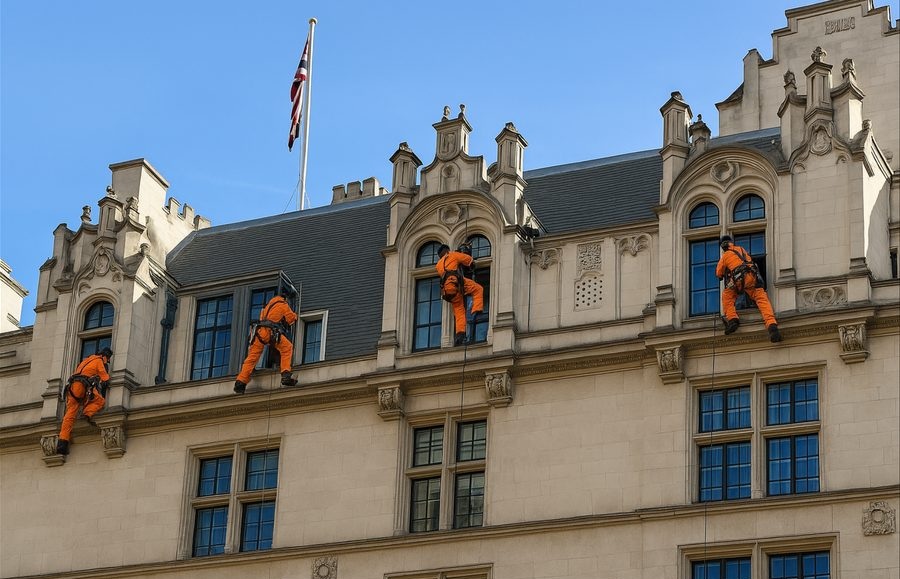



Method overview
The work starts before any rope is installed
A professional rope access method begins with deciding whether work at height can be avoided and whether collective protection or another access system would be more suitable. Only then should the building, task and rope system be planned.
Rope access is a personal work-at-height system. Its success depends on competent people, suitable equipment, independent backup, communication, supervision and a rescue plan matched to the real site.
1. Suitability and task review
The contractor reviews what must be done, where it is located, how long it will take, what tools and materials are required and whether the operative can complete the work while securely positioned. A poor task for ropes remains a poor task even if the roof has anchors.
2. Anchors and rigging strategy
Anchors, structural support, rope paths, edges and deviations are assessed. Rigging needs to place the technician where the task can be performed while limiting abrasion, shock, pendulum movement and difficult rescue positions.
3. Working and safety lines
Industrial rope access normally uses a working line and a separately anchored safety line. The system includes compatible harnesses, connectors and adjustment devices so the technician can move and remain supported at the work position.
4. Work zone and dropped objects
The area below is assessed and controlled. Tools and suitable components are secured where appropriate, materials are managed, and the exclusion zone is proportionate to the actual falling-object risk.
5. Rescue and emergencies
The team plans how an incapacitated technician could be reached, supported and recovered from the expected work positions. Rescue equipment, competence and access must be available; relying on emergency services as the primary plan is not acceptable.
6. Completion and records
The work area is checked, equipment and materials are recovered and relevant photographs or findings are issued. Defects outside the agreed scope should be recorded rather than quietly ignored or repaired without authorisation.
Client duties still matter
Facilities managers, building owners and others controlling the work should provide available information, appoint competent contractors and allow enough time for the task, access and emergency arrangements to be properly planned.
Official work-at-height guidance
The HSE requires work at height to be properly planned, supervised and carried out by competent people, with the right equipment and emergency arrangements.
Common questions
Rope access questions answered
Why are two ropes normally used?
A working line supports movement and positioning while a separately anchored safety line provides backup protection. Any departure from a two-line system requires exceptional justification and appropriate controls.
Does rope access require a rescue plan?
Yes. Work at height must include arrangements for emergencies and rescue. The plan must be realistic for the location and should not rely on the fire and rescue service as the primary solution.
Can existing roof eyebolts automatically be used?
No. Their type, intended use, inspection status, position and supporting structure must be considered. A convenient point is not automatically a suitable rope access anchor.
Who decides whether rope access is suitable?
The contractor must assess the task, building and risks. The client also has duties when controlling work at height and should provide relevant building and access information.